Golden Nova Research Center

Planetarium Show

SPACEQUEST – Explore Beyond the Sky

SpaceQuest is an exciting journey of discovery that inspires young minds to explore the mysteries of space, understand the universe, and develop a passion for science and innovation.

SpaceQuest Through a Portable Planetarium

Experience the wonders of the universe through our Portable 3D Digital Planetarium, bringing an immersive 360° space experience directly to your school campus. Students explore planets, stars, galaxies and cosmic phenomena through captivating visuals and experiential learning.

Why Planetarium Matters in Students’ Lives

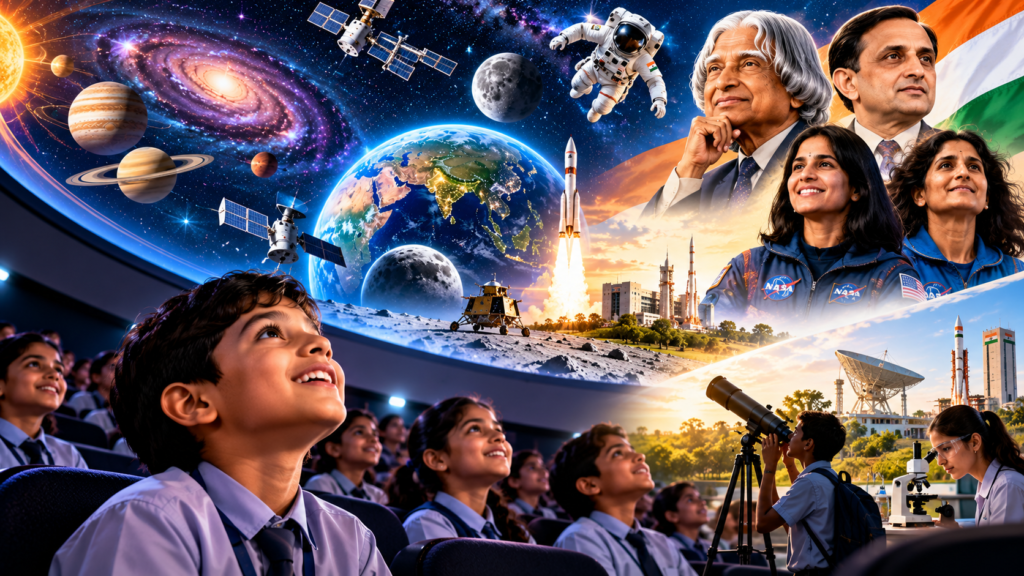
India has been inspired by great visionaries like Dr. A.P.J. Abdul Kalam, Dr. Vikram Sarabhai, Kalpana Chawla, and Sunita Williams, whose achievements have encouraged generations to dream beyond boundaries and explore the wonders of science and space.

Yet, many students remain unaware of the exciting career opportunities available in Space Science and Astronomy—not because they lack talent or ambition, but because they often lack early exposure, awareness, and guidance. While careers in Engineering, Medicine, and Civil Services are valuable, students should also have the opportunity to discover diverse scientific fields and choose their future according to their interests and abilities.

At Golden Nova Research Center LLP, through our SPACEQUEST initiative, we believe that inspiration should begin during school education itself. By introducing students from Classes 1–12 to the wonders of the universe through immersive portable planetarium shows, followed by educational visits to scientific institutions such as ISRO centres and other space science facilities, we aim to nurture curiosity, scientific thinking, and awareness of future opportunities.

Our vision is to help students look beyond conventional career choices, discover their hidden potential, and develop the confidence to pursue their dreams.

Who knows? With the right exposure, guidance, and collective efforts, today’s young learners may become tomorrow’s Dr. A.P.J. Abdul Kalam or Kalpana Chawla—bringing pride to India through their scientific achievements.

SPACEQUEST – Discover the Universe. Ignite Curiosity. Inspire India’s Future Scientists.

SPACE SCIENCE EDUCATION FOR EVERY CHILD

Bringing the Universe to Every School Campus

Practical Space Science Learning Is Not Equally Accessible

Space science has the power to inspire curiosity, develop scientific thinking, and encourage students to explore careers in science, engineering, and technology. Yet, for many students across India, learning about planets, stars, galaxies, satellites, and space missions remains largely confined to textbooks and classroom explanations.

Whether a school is located in a metropolitan city, a smaller city, a rural region, or a remote area, access to engaging and immersive space science learning experiences can be challenging.

Traditional fixed planetariums and science centres offer valuable educational experiences, but visiting them may not always be practical for every school. Distance, limited scheduling, available show timings, group capacity, transportation arrangements, academic timetables, student safety, and supervision responsibilities can make educational visits difficult to organize.

For schools located far from such facilities, these challenges can be even greater. Government schools, schools serving underserved communities, and children living in urban slum areas may have fewer opportunities to experience advanced educational activities outside their regular classrooms.

The result? Many students may never get the opportunity to experience the wonders of the universe through an immersive planetarium show.

NEP 2020: Moving Beyond Textbook-Based Learning

The National Education Policy (NEP) 2020 emphasizes experiential, inquiry-driven, discovery-oriented, and interactive learning. It encourages students to connect academic concepts with real-world experiences and develop curiosity, creativity, critical thinking, and scientific understanding.

Space science is an excellent way to bring these learning principles to life. However, meaningful exposure requires practical opportunities that schools can access conveniently and safely.

The challenge is not just teaching students about space—it is creating opportunities for them to experience and explore it.

GNRC’s Solution: A Planetarium Inside Your School

Golden Nova Research Center LLP (GNRC) is committed to making immersive space science education more accessible through its Mobile Digital Planetarium Program, featuring an immersive 3D portable dome experience.

Instead of requiring every school to arrange a visit to a distant fixed planetarium, GNRC brings the planetarium experience directly to the school campus, subject to suitable venue and technical arrangements.

Inside the dome, students can explore the universe through immersive, 360-degree visual experiences designed to make complex astronomical concepts more engaging and easier to understand.

With 20+ space science show topics, the program can introduce students to a wide range of fascinating subjects, including:

इन Planetarium Shows का उद्देश्य बच्चों में विज्ञान के प्रति जिज्ञासा विकसित करना और उन्हें 360° immersive dome experience के माध्यम से अंतरिक्ष की दुनिया से परिचित कराना है।

PART A — JUNIOR PLANETARIUM SHOWS

Recommended Classes: KG–5 | Discover, Explore & Imagine

What is Space Studies? A Comprehensive Overview | American Public University

1. Discover Our Solar System

Explore the Sun, eight planets and fascinating celestial objects in our cosmic neighbourhood.

Key Learnings:

                    • Identify the planets and their basic characteristics.

                    • Understand the Sun’s role in our Solar System.

                    • Discover how planets move around the Sun.

 
Kiedy żyły dinozaury? Trias Jura Kreda wyjaśnione • Wszystko co najważniejsze

2. Dinosaur World: A Journey Through Time

Travel back in time to explore prehistoric life and discover how life on Earth has changed across geological time.

Key Learnings

  • Discover the diversity of prehistoric animals.

                  • Understand that life on Earth changes over time.

                  • Explore the connection between fossils and scientific evidence.

Magnetic Storm May Cover Earth on April 13. The Sun: Our Star of Life

Discover our nearest star and understand why its energy is essential for life on Earth.

Key Learnings:

  • Understand the Sun as a star.

  • Learn about sunlight, heat and solar energy.

                  • Explore how the Sun supports life on Earth.


AI Wallpaper Generator: Custom AI Wallpaper Online | SuperMaker AI4. Astronomy from A to Z

An engaging introduction to the fascinating objects and basic concepts of astronomy.

Key Learnings:

  • Differentiate between stars, planets and galaxies.

                  • Discover the scale and diversity of the universe.

                  • Develop curiosity about astronomical discoveries.


Colorful aurora landscape outdoors nature | Free Photo Illustration - rawpixel

5. Wonders Above Us: Sky, Rainbows & Meteors

Explore the colourful and spectacular phenomena that make our sky so fascinating.

Key Learnings:

  • Understand how rainbows form.

                  • Identify meteors and auroras.

                  • Connect everyday observations with scientific explanations.


밤하늘에서 별자리 찾는 방법계절별 별자리와 관측 팁으로 배우는 하늘 읽기

6. Connecting the Stars: Constellation Adventures

Discover how people identify patterns in the night sky and use constellations to understand the stars.

Key Learnings:

  • Recognise constellations as patterns of stars.

                  • Understand the changing appearance of the night sky.

                  • Develop basic sky-observation skills.


Huge colorful swirling galaxy - microsoft Surface 12.4″ wallpapers (1536x1024)

7. Cosmic Colours: A Journey Through Space

Experience the spectacular colours of stars, nebulae and galaxies while exploring the beauty of the cosmos.

Key Learnings:

  • Identify different celestial objects.

                  • Explore how astronomical images reveal cosmic structures.

                  • Appreciate the connection between science and visual discovery.


Earth's orbit. Earth Rotation Around the Sun with Solar System Illustration8. Cosmic Clocks: Day, Night & Seasons

Discover how Earth’s movements create familiar patterns in our daily lives and throughout the year.

Key Learnings:

  • Explain day and night through Earth’s rotation.

                    • Understand Earth’s revolution around the Sun.

                    • Explore the relationship between Earth’s tilt and seasons.


Sun, moon, and earth solar eclipse infographic. Flat style vector illustration.9. Eclipse Explorer: Sun, Moon & Shadows

Discover the science behind solar and lunar eclipses through the movements of the Sun, Earth and Moon.

Key Learnings

  • Differentiate between solar and lunar eclipses.

                  • Understand how shadows and celestial alignment create eclipses.

                  • Learn the importance of safe solar observation.


الاستدامة في إكسبو: حماية الفضاء | World Expo10. Earth, Moon & Sun: Our Cosmic Connection

Explore the relationship between our planet, its natural satellite and the star that provides its energy.

Key Learnings

  • Identify Earth, the Moon and the Sun.

                  • Understand the Moon’s orbit around Earth.

                  • Discover how their relative positions influence observable sky phenomena.


PART B — SENIOR PLANETARIUM SHOWS

Recommended Classes: 6–12 | Explore, Investigate & Innovate

ये शो बड़े विद्यार्थियों के लिए हैं, जिनमें आधुनिक खगोल विज्ञान, भौतिक विज्ञान, अंतरिक्ष अनुसंधान और वैज्ञानिक खोजों पर अधिक ध्यान दिया गया है।


Сингулярности в черных дырах больше нет? Как на самом деле могут быть устроены черные дыры / Наука и космос / iXBT Live

1. Black Holes & Stellar Explosions

Journey into the extreme universe of black holes and supernovae to discover the dramatic life cycles of stars.

Key Learnings:

  • Understand how massive stars evolve and may end their lives.

                      • Explore black holes and their intense gravitational effects.

                      • Discover how supernovae contribute to the formation of elements.


Spiral galaxy in deep space. Elements of this image furnished by NASA.

2. From Earth to the Infinite Universe

Take a breathtaking journey from our home planet to the Solar System, distant stars and vast galaxies.

Key Learnings:

  • Differentiate between planets, stars, galaxies and the universe.

                    • Understand astronomical distances and cosmic scale.

                    • Explore the structure and vastness of the observable universe.


Nuit des étoiles filantes – 13 août 2025 | Jurassica Museum3. A Teenager’s Guide to the Cosmos

An exciting exploration of the universe designed to introduce young minds to major astronomical concepts and discoveries.

Key Learnings:

  • Understand stars, galaxies and the cosmic environment.

                    • Explore the evolution and scale of the universe.

                    • Build interest in astronomy and STEM careers.


Matière noire et neutrinos : une interaction secrète qui bouscule notre vision de l'univers ? - Lanature4. The Ghost Particle: Exploring Neutrinos

Discover neutrinos, elusive subatomic particles that help scientists investigate the Sun, supernovae and distant cosmic events.

Key Learnings:

                    • Learn the basic properties of neutrinos.

                    • Understand why they are difficult to detect.

                    • Explore how particle physics helps us study the universe.


Planet Labs launches Pelican Gen 2 technology satellite | Grafa5. Rocket Science: Defying Gravity

Discover the physics and engineering principles that enable rockets to leave Earth and carry spacecraft into orbit.

Key Learnings:

  • Understand thrust, propulsion and Newton’s laws of motion.

                      • Explore gravity and orbital motion.

                      • Learn the basic principles of rocket and spacecraft design.


Historie van Vandaag - 7 januari

6. Galileo’s Telescope: A Revolution in Astronomy

Discover how telescopic observations transformed our understanding of planets, moons and humanity’s place in the universe.

Key Learnings

  • Understand the importance of telescopic observations.

  • Discover Galileo’s observations of Jupiter’s major moons.

                    • Explore how evidence can change scientific understanding.


NASA обнаружило новую планету, где может быть жизнь – прорыв в поисках «второй Земли»7. Are We Alone? The Search for Life Beyond Earth

Investigate the search for extraterrestrial life and the scientific conditions that may support life on other worlds.

Key Learnings

  • Understand the concept of habitable environments.

                    • Explore exoplanets and the search for water.

                    • Distinguish scientific evidence from speculation about alien life.


Astrophysicien / Astrophysicienne : Formation, Salaire & Débouchés en Belgique 20268. Stellar Women: Pioneers of Astronomy

Celebrate the contributions of women scientists whose research has expanded our understanding of stars, galaxies and the cosmos.

Key Learnings

  • Discover the achievements of women astronomers.

  • Understand how observations and data advance science.

                  • Develop awareness of opportunities in STEM careers.


ChatGPTに聞いた 不思議雑学100|第17回 52位〜50位|AI図書館

9. Surviving in Space: Life Beyond Earth

Explore the challenges of human spaceflight, from microgravity and radiation to life-support systems and future missions.

Key Learnings

  • Understand how microgravity affects astronauts.

  • Discover the importance of oxygen, water and temperature control.

  • Explore the challenges of long-duration missions and space habitats.


What Is the Cosmic Web? James Webb Just Made the Clearest

10. Dark Matter: The Invisible Universe

Investigate the evidence for dark matter and explore how invisible mass influences galaxies and the large-scale structure of the universe.

Key Learnings

                    • Understand why scientists propose the existence of dark matter.

                    • Explore galaxy motion and gravitational effects.

                    • Distinguish observed evidence from unanswered scientific questions.

Why Choose GNRC’s Mobile Planetarium?

1. Learning at the School Campus
Bring an immersive space science experience to your students without making a distant planetarium visit the only option.

2. Immersive Visual Learning
Help students visualize astronomical concepts through dome-based, 360-degree presentations that complement classroom teaching.

3. Access Beyond Major Cities
Extend opportunities for space science awareness to schools in smaller cities, rural areas, and locations where fixed planetarium facilities may be difficult to access.

4. Designed for Educational Use
Select age-appropriate show topics for different student groups, with the aim of supporting curiosity, conceptual understanding, and scientific awareness.

5. Convenient School-Level Planning
Coordinate the program on campus according to school schedules, available space, student batches, and operational requirements.

6. A More Inclusive Learning Opportunity
Enable more children—including students in government schools and underserved communities—to experience space science through accessible educational initiatives.

Our Vision: Space Science Education for All

At GNRC, we believe that a child’s opportunity to explore the universe should not be determined solely by the city they live in or the resources available at their school.

Every child deserves opportunities to ask questions, discover new ideas, imagine possibilities, and develop a scientific outlook.

Our mission is to help bridge the gap between textbook knowledge and immersive learning by bringing space science experiences closer to students—one school campus at a time.

Bring the Universe to Your School!

Give your students an opportunity to look beyond textbooks and explore the wonders of space through GNRC’s Immersive 3D Portable Dome Planetarium Show.

Planetarium Show

Immersive 3D Planetarium Experience

Golden Nova Research Center LLP (GNRC) brings the wonders of space directly to schools through an immersive 3D Mobile Planetarium experience. Our specially designed dome transforms an ordinary school space into a fascinating journey through the universe, allowing students to explore planets, stars, constellations, galaxies and other celestial wonders in an engaging visual environment.

Unlike a traditional fixed planetarium, our portable planetarium travels to the school campus, making space science learning accessible to students without the need to visit a city-based planetarium.

The experience combines science, storytelling and immersive visuals to make complex concepts of astronomy easier and more enjoyable to understand. Students don’t just learn about space—they experience it.

Learning Beyond the Classroom

Our planetarium shows are designed for students from KG to Class 12, with age-appropriate content aligned with the learning needs of different classes. The sessions support NEP 2020’s emphasis on experiential and activity-based learning and complement STEM education.

Through the immersive dome experience, students can:

  • Explore the Solar System and planets
  • Understand stars, constellations and galaxies
  • Discover the Moon, Sun and other celestial bodies
  • Learn about space exploration and India’s achievements in space science
  • Develop curiosity about astronomy, science and future careers
  • Experience scientific concepts through visual and experiential learning

GNRC’s Mobile Planetarium brings the sky closer to students—turning curiosity into learning and learning into inspiration.

Scroll to Top